Yesterday’s storm left a mark on Toronto that property managers across the GTA are still dealing with this morning. The Don Valley Parkway flooded. Sixty-five thousand homes lost power. Basements filled with water across North York, Scarborough, and Etobicoke. If your building took on water during the September 2 storm, the decisions you make in the next 24 to 48 hours matter more than anything that comes after.
This guide covers exactly what to do, in what order, and why speed is everything when storm water enters a building.
Why Yesterday’s Storm Was Different
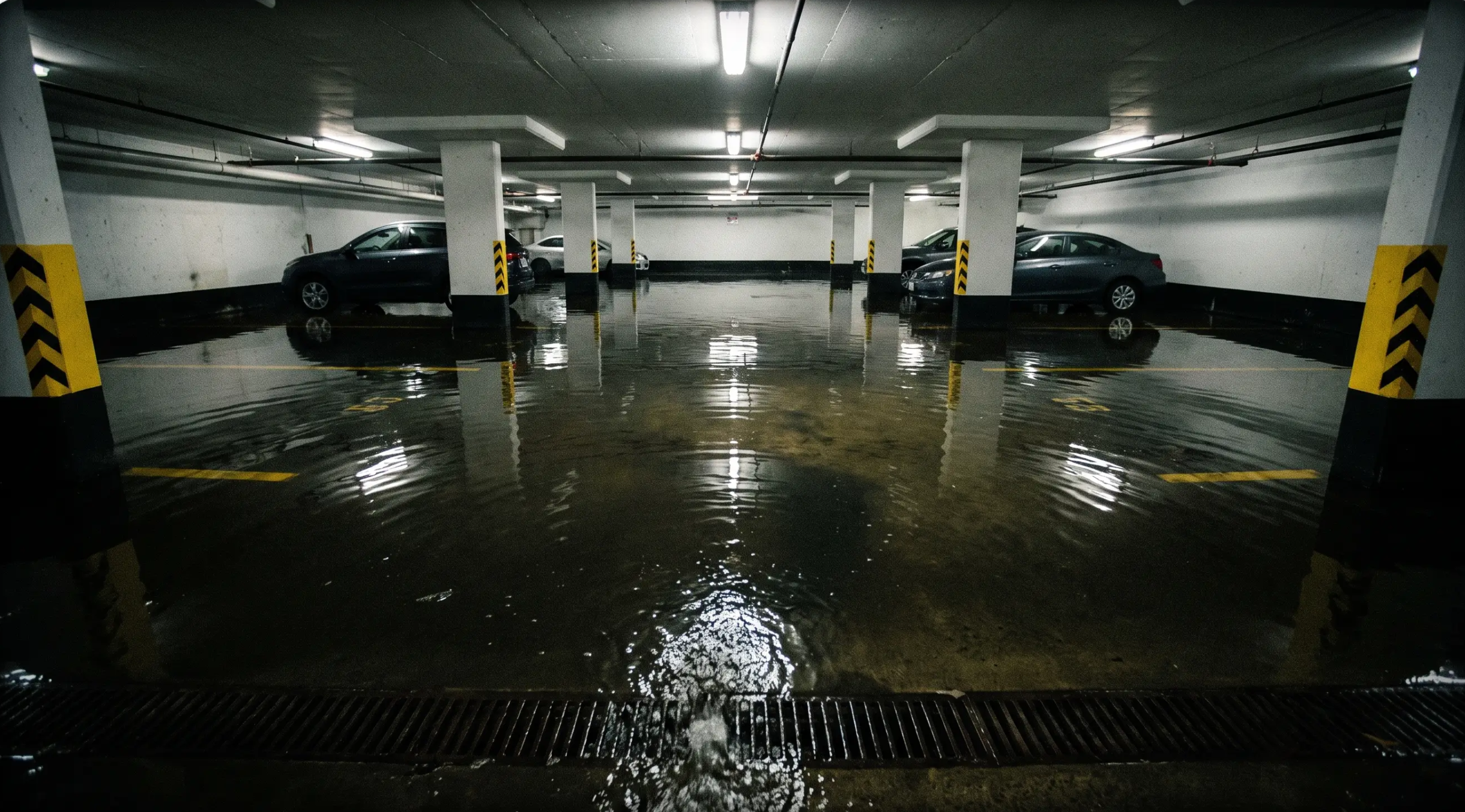
Environment Canada classified the September 2, 2026 storm as an extreme weather event. Golf ball-sized hail, winds strong enough to tear roofs off buildings, and rainfall volumes that overwhelmed the city’s drainage infrastructure all at once. This was not a typical summer thunderstorm. The city’s sewer systems were already overwhelmed when the second storm cell moved through, which means buildings that flooded did not flood from roof leaks alone. Water came up through floor drains, through foundation walls, and through underground parking level drains as the municipal system backed up.
That type of flooding carries contaminated water. That changes the restoration approach entirely.
The First 48 Hours Are Critical
Water damage follows a predictable timeline. Clean water from a broken pipe is manageable for the first 24 hours. Storm water that has mixed with the municipal sewer system becomes a different category of problem within hours. It carries bacteria, sediment, and contaminants that affect how materials are handled and disposed of during remediation.
Mold growth begins within 24 to 48 hours of water exposure in areas with poor airflow. Wall cavities, subfloors, and ceiling assemblies trap moisture long after the visible surface appears dry. Without professional drying equipment, moisture stays trapped in the structure and mold establishes itself quickly.
For property managers overseeing condo buildings, the stakes are higher than a single unit. Storm water that enters through a parking garage drain or a basement mechanical room can travel through the building’s structure to units on multiple floors before anyone notices.
What to Do Right Now
Stop the water source if it is still active. If water is still entering the building through a compromised roof membrane, a cracked foundation wall, or a backed-up drain, contact your mechanical team immediately. Restoration cannot begin while water is still entering.
Document everything before anyone touches anything. Before any cleanup starts, photograph every affected area in every unit. Video the parking garage, the mechanical room, the corridors, the lobby. This documentation is the foundation of every insurance claim that follows. Once materials are removed or moved, the original damage record is gone and cannot be recreated.
Notify your insurance provider today. Most commercial property policies require reporting within 24 to 48 hours of a loss event. Missing that window can complicate or void a claim. Contact your insurer before the end of the business day and get a claim number.
Notify affected residents immediately. Unit owners and tenants need to know what happened, what is being done, and what to expect. Clear communication from the property manager in the first few hours prevents the panic and complaints that make a difficult situation worse.
Call a certified restoration company. This is not a job for building maintenance staff or a general contractor. Storm water damage that involves potential sewage contamination requires trained technicians with the right equipment and safety protocols. Industrial extraction equipment, commercial dehumidifiers, thermal imaging cameras, and moisture meters are all needed to assess and remediate this properly.
At Imperial Restoration, our team has been responding to yesterday’s storm calls since Wednesday night. We are still responding across Toronto and the GTA today.
Understanding Contamination Categories
Not all water damage is the same. Restoration professionals classify water damage into three categories that determine how materials are handled.
Category 1 is clean water from a supply line or rainfall through a roof before it contacts any contaminated surface. Category 2 is gray water that carries some contamination, such as washing machine overflow or mild flooding. Category 3 is black water, which includes sewage backup, flooding from municipal overflow, and any water that has been sitting long enough to grow bacteria.
Yesterday’s storm flooding in most GTA buildings falls into Category 2 or Category 3 depending on how the water entered. Any building that experienced backup through floor drains or sump pits is dealing with Category 3 water. Materials that contact Category 3 water, drywall, carpet, insulation, wood framing below the waterline, typically cannot be dried and reused. They need to be removed and disposed of properly.
This is a critical distinction for property managers dealing with residents and insurance adjusters. A Category 3 loss has a different scope, different costs, and different documentation requirements than a Category 1 loss.
What Professional Storm Water Restoration Covers
A proper storm water restoration program for a condo building covers assessment, water extraction, structural drying, contamination treatment, material removal where required, and complete restoration of finishes. For a building affected by yesterday’s storm, that typically means:
Water extraction from parking garage levels, mechanical rooms, lobby areas, and affected units. Industrial air movers and dehumidifiers positioned throughout the building to dry the structure properly over three to five days. Moisture mapping using thermal imaging cameras to identify water that has migrated behind walls and under flooring without visible surface signs. Antimicrobial treatment of all affected surfaces to prevent mold establishing itself during the drying period. Documentation of all damage with moisture readings, photographs, and written scope reports that satisfy insurance adjuster requirements.
Once the structure is dry and certified, restoration of damaged drywall, flooring, ceiling tiles, and finishes returns the building to pre-loss condition.
For the building envelope work that often follows major storm events, including flat roof membrane repair, masonry crack sealing, and waterproofing of foundation walls, our building envelope restoration team handles that as a separate coordinated program.
Coordinating Insurance for a Multi-Unit Building
One of the most complex parts of storm damage in a condo building is insurance coordination. A single storm event can involve the corporation’s master policy, individual unit owner policies, and in some cases the policies of tenants or commercial occupants in the building. When water damage crosses from a common element into a private unit, or from one unit into a unit below, multiple policies are triggered.
Property managers who handle this well start by documenting damage by zone before any cleanup begins. Which damage is in common elements? Which damage is inside a standard unit? Which damage is to improvements an owner made above the standard unit bylaw? Clear documentation from the start keeps each party’s insurer working from the same factual record.
Imperial Restoration works directly with all major insurance carriers in Ontario. We provide moisture readings, photographic documentation, and written scope reports formatted for insurance adjuster review. That documentation package is what gets claims processed without delays or disputes.
For buildings in the Toronto service area and across all GTA regions, we coordinate directly with property managers and insurers from the first site visit through final restoration sign-off.
After the Emergency: Preventing the Next One
Yesterday’s storm exposed vulnerabilities in a lot of GTA buildings. Flat roof membranes that were due for replacement held on through a normal summer but failed under this volume of water. Foundation drain systems that were adequate for typical rainfall were overwhelmed. Parking garage waterproofing that had been deferring failure for a season finally gave way.
Now is the right time to schedule building envelope inspections while the evidence of where your vulnerabilities are is still visible. Identifying and addressing those vulnerabilities before next spring is less expensive than responding to another emergency restoration event.
If you are dealing with storm damage from yesterday’s flooding, contact Imperial Restoration directly for emergency response across Toronto and the GTA.
Phone: (647) 621-2429
Email: contact@imperial-restoration.ca
Website: imperial-restoration.ca
Available 24/7. Serving Toronto, North York, Scarborough, Mississauga, Brampton, Vaughan, Markham and all GTA areas.
How quickly does storm water damage turn into mold in a Toronto building?
Mold can begin developing within 24 to 48 hours of water exposure, particularly in areas with limited airflow like wall cavities and under flooring. In warm September conditions like this week, that timeline can be shorter. Professional drying with commercial equipment is the only reliable way to prevent mold from establishing itself after storm flooding.
Is yesterday’s Toronto storm flooding covered by insurance?
Coverage depends on your specific policy. Most commercial property policies cover sudden and accidental water damage. Overland flooding from the municipal system is covered under some policies and excluded from others. Review your policy with your broker today and file your claim as quickly as possible. Timely reporting protects your claim.
Who is responsible for storm damage in a Toronto condo building?
Responsibility depends on where the damage occurred and your building’s declaration and Standard Unit Bylaw. Common elements and the building structure are typically the corporation’s responsibility. Standard unit finishes and owner improvements are typically the unit owner’s responsibility. When storm water damages both, two separate insurance claims are often involved. Your property manager and legal counsel can confirm the specifics for your building.
Can building maintenance staff handle storm water cleanup?
Not safely in most cases. Storm water that has mixed with municipal drainage carries contamination that requires specific handling protocols. Standard building maintenance is not equipped for Category 2 or Category 3 water damage. Using untrained staff for contaminated water cleanup also creates liability exposure for the corporation.
How long does storm water damage restoration take in a condo building?
A contained event in one or two units typically takes three to five days of monitored drying followed by one to two weeks of restoration work. A larger event affecting multiple floors or common areas takes longer depending on the extent of water migration and material removal required. Imperial Restoration provides a phased schedule at the start of every project so property managers can plan resident communication and access around the work.